Something's happening in workplaces right now that's creating an impossible situation for millions of professionals.
On one side: organizations expect more productivity. Headcount is flat or shrinking. The work didn't go away - it just got redistributed across fewer people. The implicit message: AI tools will help you handle the increased load.
On the other side: nobody's giving people time to actually get good at AI.
This creates what feels like a paradox: the same pressure creating the incentive to adopt AI is the same pressure stealing the time you'd need to actually learn it well.
AI Adoption Is a Practice Skill
Getting value from AI tools right now isn't like learning a new software feature. You can't simply watch a tutorial, tick a box, and move on.
It's a practice skill. Like playing an instrument. Like learning a language.
Right now, using AI effectively requires developing several interconnected capabilities:
Prompt engineering - learning to communicate with AI in ways that produce useful outputs. This isn't about memorizing magic phrases. It's about understanding how AI interprets instructions and developing intuition for what works.
Context management - AI doesn't know what you know. Learning to provide the right context, in the right amount, at the right time is a skill that develops through practice.
Systematic thinking - breaking your work apart so pieces can be strategically handed to AI, then chaining those pieces together into larger workflows. This requires seeing your work differently than you might be used to.
An engineering mindset - thinking about inputs, processes, outputs, and iteration. Even if you never write code, using AI well requires a kind of engineering thinking about how to set the tool up for success.
This is a whole skillful bucket of activities. And like any practice skill, it takes time and repetition to get good.
The Two Forces Creating the Squeeze
Force 1: Workplace Density
Organizations are not growing headcount. Many are actively reducing it. The work that remains gets redistributed among fewer people, making each person's workload more dense.
This density means less slack in the system. Less time for learning. Less capacity for anything that doesn't have an immediate deliverable.
The irony is thick: AI tools could reduce this pressure, but there's no time to learn them because of the pressure.
Force 2: Life Outside Work
Okay, so maybe people learn AI outside work hours?
Except: everyone has a life. Family responsibilities. Rest that's necessary for sustainable performance. Personal interests that make work worth doing in the first place.
The idea that people should sacrifice their personal lives to learn a work skill - even an important one - isn't just unsustainable. It's a recipe for burnout and resentment.
And yet, for many people, this feels like the only option. Tutorials at 10pm. YouTube videos on weekends. Grinding through courses when they should be recharging.
Will the Tools Eventually Get Easier?
Probably. Yes.
The gap between "I want this" and "AI does it correctly" will likely shrink over time. The tools will get better at understanding what we mean. The practice curve will flatten.
But that's eventually. Right now, we're in a window where the skills matter.
In this interim period, the professionals who develop real AI capability will have genuine advantages. They'll be able to do things others can't. They'll see possibilities others miss. They'll be the ones organizations rely on when AI really matters.
The question isn't whether these skills will matter - it's how people are supposed to develop them given the constraints they're under.
What Actually Works
We've coached a lot of people through AI adoption. People from non-technical backgrounds learning to build things they couldn't have imagined before. What we've learned: the barrier is rarely technical.
It's emotional. It's motivational. It's having permission to spend time on something that doesn't have an immediate deliverable.
Here's what actually moves the needle:
Dedicated Practice Time
Not "I'll try to fit it in." Actual time, on the calendar, protected from other demands. This sounds obvious, but most people never do it.
Even 20-30 minutes of focused practice, done consistently, compounds faster than sporadic hour-long sessions.
Community
Learning alongside other people who are figuring it out too changes everything. You see approaches you wouldn't have thought of. You normalize the struggle. You have people to celebrate wins with.
The path forward reveals itself through doing - but doing together makes it clearer.
Accountability
Someone who notices when you don't show up. Not in a punitive way - in a supportive way. The kind of accountability that comes from being part of something you don't want to let down.
Support Through the Messy Middle
AI doesn't work right the first time. Or the second. Often not the third. This is normal, but it doesn't feel normal if you're struggling alone.
Having people who can say "yeah, that happened to me too, here's what helped" - that's the difference between giving up and breaking through.
The Real Skill Is Showing Up
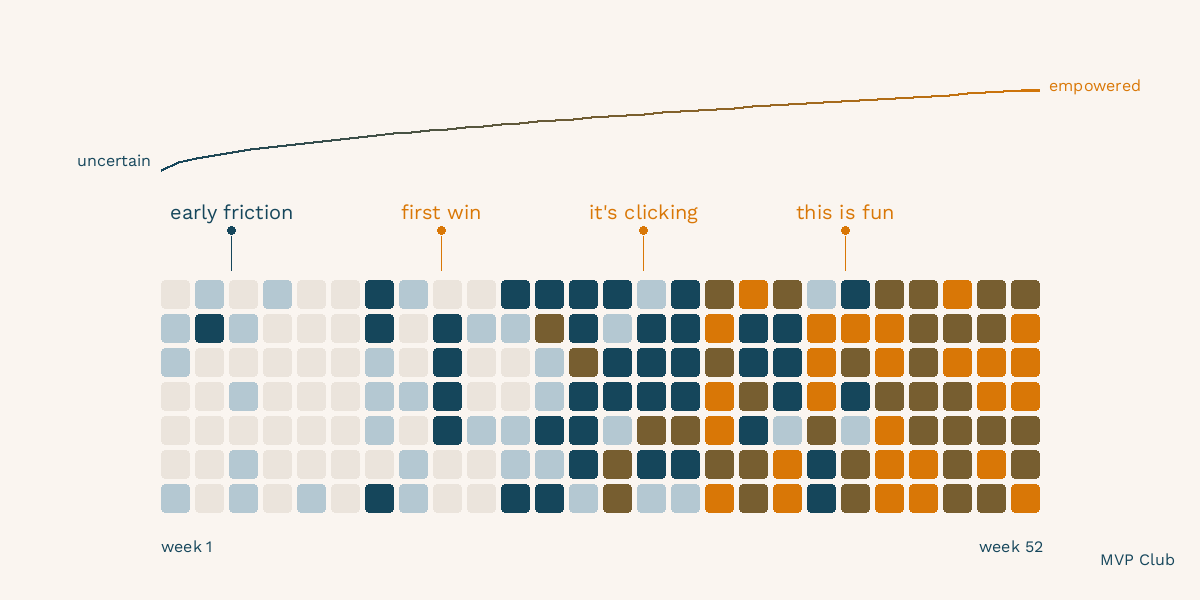
Getting good at any practice skill is more of an emotional and motivational journey than a technical one.
The techniques matter. The prompting strategies matter. The workflow thinking matters.
But what matters most is consistently showing up and doing the work. And that's a human challenge, not a technical one.
Having people in your corner - people who understand the struggle, who celebrate your progress, who hold you accountable with kindness - that changes what's possible.
Finding Your Time
The time paradox is real.
But within the constraints, there are choices. Protecting small windows of practice time. Finding community that makes showing up easier. Letting go of the idea that you need long stretches to make progress.
At MVP Club, we've built around this reality. Live practice sessions twice a week - not content to watch, but time to actually use the tools together. We create project structures that folks can follow and complete over the course of weeks and months, learning valuable skills along the way. It's a community of people navigating the same challenges. Accountability that's supportive rather than punishing.
Because the answer to "how do I find time to practice?" often starts with "who are you practicing with?"
Key Takeaways
- AI adoption is a practice skill requiring prompt engineering, context management, systematic thinking, and an engineering mindset
- The Time Paradox: increased productivity pressure creates the need for AI skills while stealing the time to develop them
- The barriers are emotional and motivational, not primarily technical
- What works: dedicated practice time, community, accountability, and support through the messy middle
- Consistent small practice beats sporadic intensive sessions
MVP Club is a coaching company helping white-collar professionals adopt AI through practice-based coaching. We meet live twice a week to practice together, share what's working, and support each other through the learning journey.