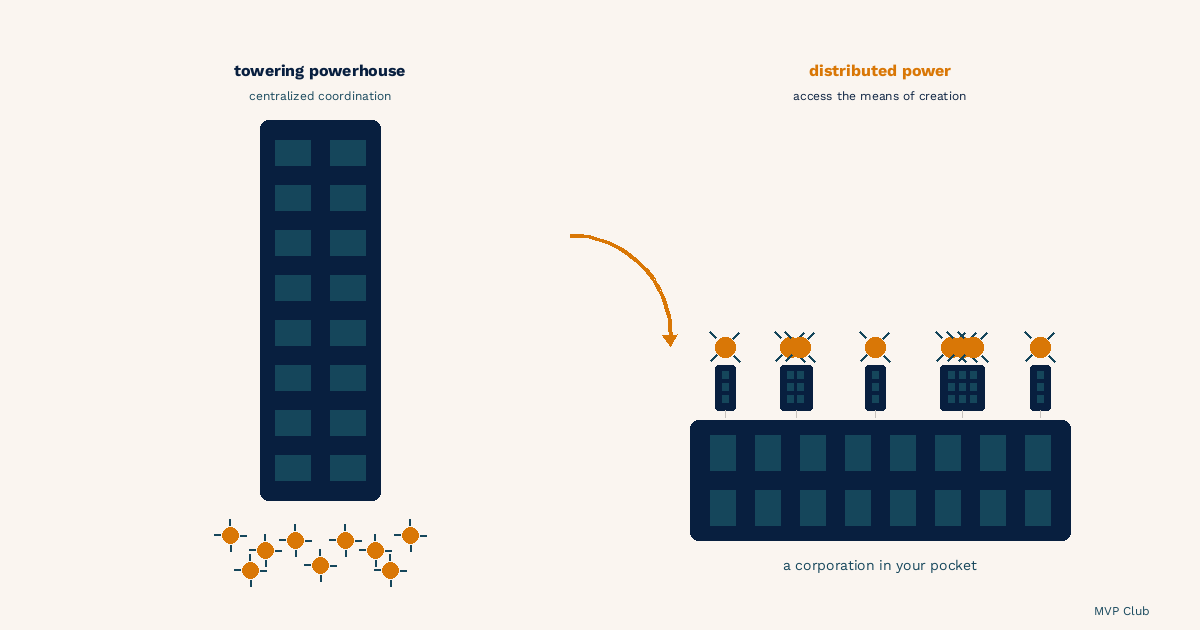
A lot of white-collar work is getting abstracted away. The coordination, the judgment calls, the procedural stuff that companies employ thousands of people to do—LLMs are starting to handle it. That work gets black-boxed behind models, and ownership of those models becomes a commodity service. The whole white-collar economy starts to look less like a complex world of human coordination and more like... infrastructure.
I've been sitting with this idea since writing about replacing your employer. That piece was about flipping the script—instead of worrying about companies replacing you with AI, asking whether you could use AI to replace your need for an employer. But there's a bigger picture underneath it.
If the work itself becomes infrastructure, what happens to the power that used to come with controlling it?
What Does It Mean for White-Collar Work to Become Infrastructure?
Infrastructure is the boring, reliable layer that everything else gets built on top of. Electricity. Roads. Water systems. You don't think about them—you just use them. When white-collar work becomes infrastructure, the coordination and judgment that companies built empires around becomes a utility that anyone can access.
Think about what corporations actually provide:
- Direction (deciding what to work on)
- Coordination (organizing people toward a goal)
- Judgment calls (evaluating options, making decisions)
- Procedural execution (getting the steps done)
Companies spent decades hiring thousands of people to do this work. It's how they created value. It's what made them powerful.
Now imagine all of that becoming a platform. Not something you need permission to access, not something that requires a certain job title or corporate affiliation—just... available. Like electricity.
Is This Actually Happening?
MAYBE, but slowly and unevenly. We're early in this transition. Some coordination and execution work is already getting commoditized. Other parts are still firmly human territory. The direction is clear even if the timeline isn't.
I'm not saying AI can do everything a corporation does right now. That would be wrong. But the trajectory is pretty obvious if you're paying attention.
What's already commoditizing:
- Research and analysis that used to require teams
- Document creation and revision
- Process automation
- Code generation
- Decision support on well-defined problems
What's still firmly human:
- Deciding what to build in the first place
- Taste and creative direction
- Navigating genuinely ambiguous situations
- Building trust and relationships
- Understanding what people actually want
The gap is closing. And it's closing faster than most people expect.
What Happens to Corporations When This Shift Completes?
Corporations don't disappear, but they lose something important: the power to be taste-makers. They stop being the ones who decide what gets built, what's valuable, what the hot product is. They become the boring foundation layer.
This is the part I keep coming back to.
Right now, corporations are the ones who decide what gets created. Not because they have better ideas than individuals, but because they have the infrastructure to execute. Building something meaningful required access to coordination, capital, distribution, talent. Corporations had it. Individuals didn't.
But if the execution layer becomes commodity infrastructure, what's left?
What's left is deciding what to build. The taste. The judgment about what's valuable. The creative direction.
And that doesn't require a corporation.
Who Gets That Power Instead?
The power to decide what gets built shifts to individuals and small groups. Communities figuring out what to create on this new platform. People who develop taste and judgment, not people who control execution infrastructure.
This is the exciting part, if you let yourself be excited about it.
The bottleneck stops being "who has the capability to build?" and starts being "who has the taste to know what's worth building?"
That's a fundamentally different kind of power. And it's more distributed. You don't need permission to have good taste. You don't need to climb a corporate ladder to develop judgment about what people want.
You do need to develop that judgment, though. Which is a new kind of challenge.
What Does "A Corporation in Your Pocket" Actually Mean?
It means the capability that used to require corporate infrastructure—teams, processes, capital, distribution—becomes accessible to individuals. Not identical to what corporations provide, but close enough that the power dynamic shifts.
I've been saying this phrase and I want to be specific about what I mean.
I don't mean you'll be able to replicate every function of a Fortune 500 company from your phone. That's not realistic and probably not desirable.
I mean the gap between "idea I have" and "thing that exists in the world" gets dramatically smaller. The execution capability that used to be locked behind corporate walls becomes available to anyone with the judgment to use it well.
That changes who gets to create. It changes who gets to try things. It changes who gets to fail and learn and try again.
Is This Utopian Wishful Thinking?
No. The transition will be messy. A lot of people will struggle. Some will thrive and others will get left behind. But the end state might be more distributed power, not less. That's not utopian—it's just a different configuration.
I'm not saying everyone will be fine. I'm not saying the transition will be smooth. I'm not saying there won't be real pain.
There will be. There already is.
But "this will be hard" and "this might end up somewhere better" can both be true. The industrial revolution was devastating for a lot of people while it was happening. The end state—most people not being subsistence farmers—was arguably better.
I don't know if this analogy holds. Nobody does. We're living through something without a clear historical precedent.
What I do know is that sitting in fear doesn't help. And that the people who will thrive are probably the ones developing new capabilities right now.
What's the Practical Question Here?
The question is: are you ready to be the one deciding what to build? Or are you waiting for someone to tell you?
This is where it gets real.
If the power shifts from "controlling execution" to "having taste about what to create," then developing that taste matters. Practicing the judgment matters. Getting reps on deciding what's worth building—and then building it—matters.
Most of us have spent our careers having challenges assigned to us. School gave us assignments. Jobs gave us tasks. We showed up, we executed, we got paid.
That muscle—giving yourself meaningful challenges—is underdeveloped for most people. Including me.
But it's learnable. And this might be the most important moment to learn it.
How Do You Start Developing This?
Start by asking: what would I build if I didn't need anyone's permission? What challenge would I give myself? Even if you don't act immediately, the question shifts your orientation from passive to active.
I don't have a five-step program for this. I'm not sure anyone does.
But I've noticed some patterns from coaching people through this:
Start small. Don't try to reinvent your industry. Pick a problem you actually have. Something that annoys you. Something you wish existed. Build a small version of a solution.
Build for yourself first. The best taste comes from solving problems you actually understand. You understand your own problems better than anyone else's.
Practice the full loop. Idea → build → evaluate → iterate. The judgment develops through completing cycles, not through planning.
Find people to do this with. This is harder alone. Having others who are building, sharing what works, figuring it out together—that makes it sustainable.
What's the Takeaway?
The work is becoming infrastructure. The power is shifting to whoever has taste about what to create. This transition is messy and uncertain. But the people who start building now—who practice giving themselves challenges and developing judgment—will be better positioned than those who wait for permission.
I don't know exactly what the future looks like. Nobody does.
But I'm pretty confident that waiting for corporations to tell us what's valuable isn't the right move. The window where that strategy makes sense is closing.
The question isn't whether you'll be affected by this shift. You will. We all will.
The question is whether you'll be ready to create when the capability shows up in your pocket.